
Opening boards
One of many green shoots sprouting up in response to Trump’s oppression
Friends,
Boards of directors of America’s largest and most consequential nonprofits — stewards of the greatest of the nation’s museums, universities, charities, operas, libraries, arts organizations, and foundations — are now dominated by wealthy men who have made it in the world of finance.
This was not the case thirty or forty years ago, when many of people who served on prestigious boards had distinguished themselves by their erudition, creativity, or leadership in some other capacities.
But as the wealth of the nation has moved to the top — and as the way to the top has become greased with private equity, hedge funds, venture capital, and IPOs — the nonprofit sector has increasingly been drawn to financiers who can write large checks, and who expect to be placed on boards to ensure that their large checks are spent in ways they approve of. (The stewards of America’s nonprofits have become many of the same people who write large checks to aspiring politicians, with similar expectations.)
As a result, many boards of directors have become prestigious rich clubs of people who know very little about, say, higher education or history or the arts, but whose wealth has given them a large say over how America’s universities, museums, and artistic institutions function. Dominated by finance, they have become bastions of old-boy privilege, Wall Street conservatism, and self-replicating timidity.
Like much else in American life, this trend has been exposed by Trump’s rampage. Many of the great nonprofits of America have surrendered to the arbitrary whims and demands of America’s first dictator because the financiers who sit on their boards figure it’s better to make a deal with him than to lose more federal funding. They’re used to making deals, and they feel no particular fealty to the underlying values of their nonprofits.
Notably, ten of the 19 trustees on the board of Columbia University — one of the most cowardly of all major universities in surrendering to Trump — have ties with the financial sector and only one has prior academic experience.
Yet one of the green shoots of hope emerging from Trump’s oppression is a long-overdue focus on institutional governance, and a movement to break the chokehold of finance.
In a recent interview with the Columbia Spectator (from which much of this post is drawn), Michael Thaddeus, professor of mathematics and acting president of the Columbia chapter of the American Association of University Professors, called universities “a microcosm of society” and stressed the importance that governance has for Columbia. “Society is taking this authoritarian turn right now, which is very worrisome,” Thaddeus said. “Do we as a university want to be a mini autocracy, or do we want to be a mini democracy? We need to be a mini-democracy.”
In July, Columbia struck a $221 million agreement with the Trump regime to settle pending civil rights investigations and restore most federal grants that Trump had terminated in March. The deal, which ranges from giving the federal government admissions data of both rejected and admitted students to asking international applicants why they wish to study in the United States, was criticized by faculty, students, and alumni.
Last fall, Barnard and Columbia claimed the bottom two spots in the Foundation for Individual Rights and Expression’s 2026 College Free Speech Rankings.
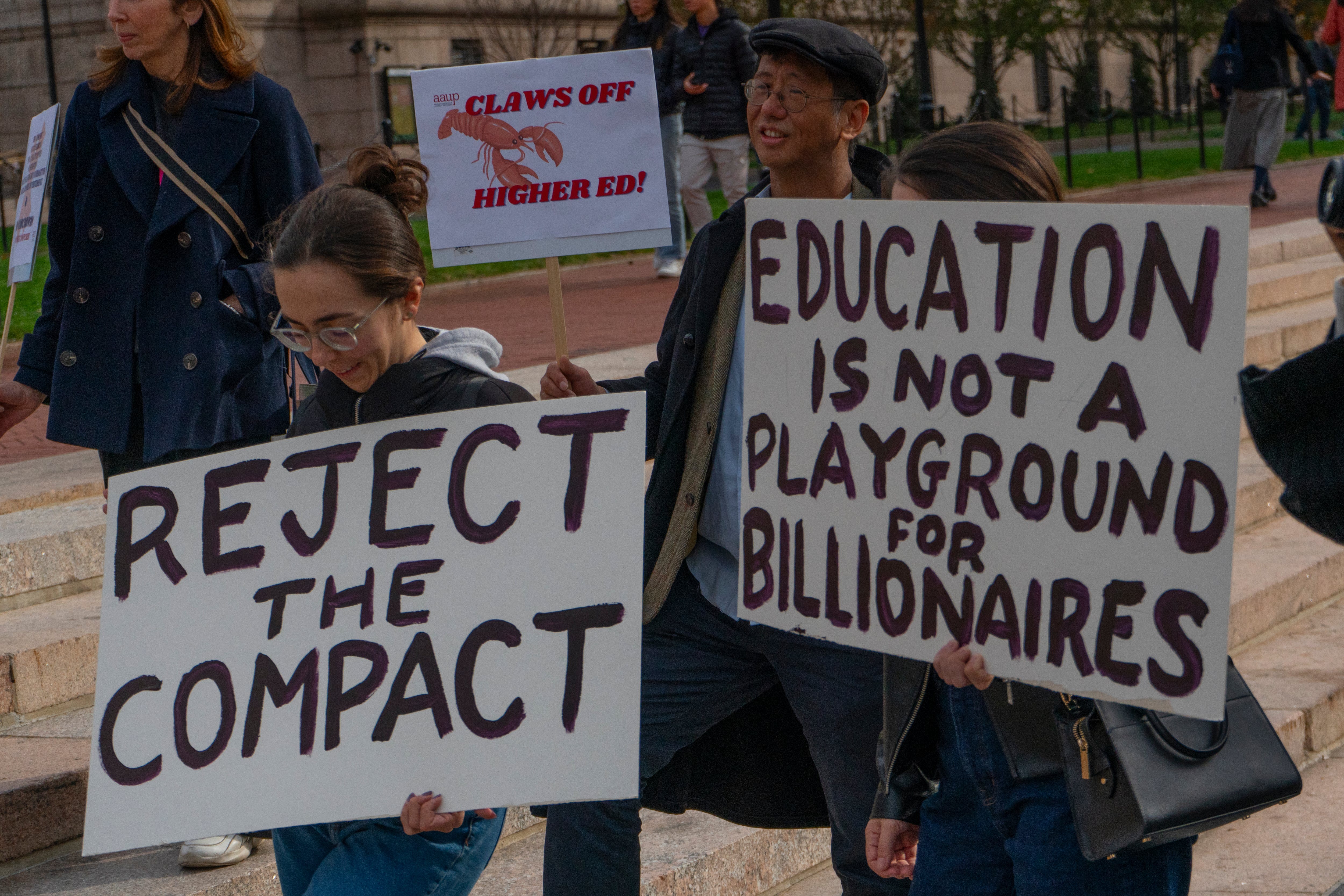
Now, the Columbia chapter of the American Association of University Professors is calling for sweeping changes to the University’s board of trustees. **
It charges that the university’s settlement with the Trump regime “limits the exercise of academic freedom, acquiesces to limits imposed on the admission of foreign students, and establishes new forms of oversight for some academic units, among other unprecedented provisions.”
The Columbia AAUP wants open nominations and “competitive direct elections” for half of the seats on the board and greater transparency, communication, and engagement with University stakeholders:
“The Board cannot regain the trust of the University community if it eschews basic norms of accountability and transparency and if the University’s highest governing authority remains insulated from the people it serves …. rapid Board reform is imperative.”
“This imbalance restricts the range of expertise and lived experiences that should inform the governance of a modern research university, where the Board’s mission extends far beyond financial stewardship.”
It charges that “in the last year and a half, problematic Board actions have accelerated, endangering and alienating many students, faculty, and staff,” noting that such actions have contributed to Columbia’s “catastrophic loss of reputational stature.”
It also states, “While not all of Columbia’s current precarious situation can be laid at the feet of the Board, considerable blame must rest there.”
The Columbia AAUP specifies several guidelines and ethical principles expected of the board, including a diversity of expertise, representativeness of the university population, transparency, and “mitigation of conflicts of interest.” It says the “crisis of confidence” in the board is “profound and widespread” and states that “substantial, rapid, and principled reform is no longer optional. Now is the time to act.”
It calls on trustees to “uphold the institution’s own Statutes and shared governance structures and to exercise independent judgment rather than yielding to external political pressure or administrative expediency” in the name of fiduciary responsibility. It argues that “a more democratically constituted Board is a critical first step towards broader democratic practice” and calls on the board to institute direct elections for seats, and make meeting minutes publicly available to “increase trust, visibility, fairness, and accountability.”
Michael Thaddeus hopes the statement will open debate about the lack of direct communication between the Columbia community and the board, adding that he believes it could serve as a starting point for change. “We just want to plant the seed of the idea that a great university in a free society should not be run by a self-perpetuating, oligarchic board. It should be run by a democratically elected board that is responsive to constituents and stakeholders.”
Jean Howard, the George Delacorte professor emerita in the humanities, said the Columbia-AAUP would “love to have meetings with a select group of the board,” and in the meantime, must “make a lot of public noise too.”
Adam Reich, professor of sociology (and, full disclosure, my son) said he hopes the AAUP statement will reach beyond the board of trustees to those “at the heart of this institution,” such as students, faculty, and other community members. “It’s sort of up to us to reimagine what the board ought to be and make it happen,” Reich told the Spectator.
It’s too early to tell whether Trump’s arbitrary repression of academic freedom in American universities will paradoxically result in a flowering of democratic accountability there. But university boards of trustees are among the most insular and self-perpetuating of all American institutions. If those boards are opened, academia will be both more accountable and freer.
** The link for people (Columbia alumni, faculty, others) who want to get involved can be found here.
It has become not only the fashion but the dominant paradigm in the United States to value only the fungible, which has led to wealthy and wealth-focused know-nothings running the country and the major institutions. That the nation has become focused on the short run has made things worse.
They neglect the fundamental national assets of human beings (with our knowledge and skills and knacks and thinking powers and strengths), of the air and water and soil, of tangible and intangible networks of interconnection among humans and among our fellow creatures and between us humans and our environment.
Awakening means taking off these extremely limiting blinkers and throwing the bums out.
Prognosticators are predicting a weather event that could cripple this country.
Donald Hodgins <silencenotbad@gmail.com>
3:52 AM (
There is an ice storm developing across this country that has the ability to devastate life as we know it for the foreseeable future. This event or ones similar to it descend upon us almost every Winter. However, this year we are being warned that the approaching storm will be catastrophic in nature. Our Southern tier states are bracing themselves for the worst. While another ICE storm of equal concern is already devastating cities in our North, like Minneapolis. The Republican Party has developed a distaste for immigrants who crossed our Southern border on foot. I find it odd they show no concern for the some 80 million immigrants who have entered this country over the past 75 years VIA either one of our two coasts. I have no problem with immigration officials removing individuals who have committed crimes of a felonious nature. ICE agents "MUST" present local officials with a list of their targets along with proof of the crime or crimes they have committed. For ICE to randomly extract law bidding people from our midst strictly because of their appearance is asinine. It's a proven statistic that immigrants commit fewer crimes than our own citizens. We live in a country built upon the dreams of immigrants, why does the party of our President view our new arrivals in a negative light? Weed out the criminals but leave the people of quality be. The debacle in Minnesota that's being prosecuted by morons like Noem, Vance, and Trump are a disgrace to this country and the freedoms we give to all who live within our borders. The effects of the storm to our South will subside as the ice melts. Perhaps we should apply a little political heat to the ICE in our North and see what happens. Leave the people be!